Picture this scene from a typical Monday morning in 2024. Jennifer sits in a conference room with her design team at a software company in Austin. The walls are covered with sticky notes from last week’s brainstorming session. Her laptop displays a dozen browser tabs with competitor websites, design inspiration sites, and half-finished mockups. The team has been working on redesigning their company’s main product dashboard for three months, and they’re still arguing about basic layout decisions.
“We need more user research,” says Tom, the UX designer, for what feels like the hundredth time.
“We don’t have time,” Jennifer responds, checking her watch. “The CEO wants to see something by Friday.”
This scene plays out in thousands of companies every day. Design teams struggle with impossible deadlines, endless revisions, and the constant pressure to deliver something innovative while also safe, beautiful while also functional, fast while also perfect.
Now let me take you forward just six years to 2030.
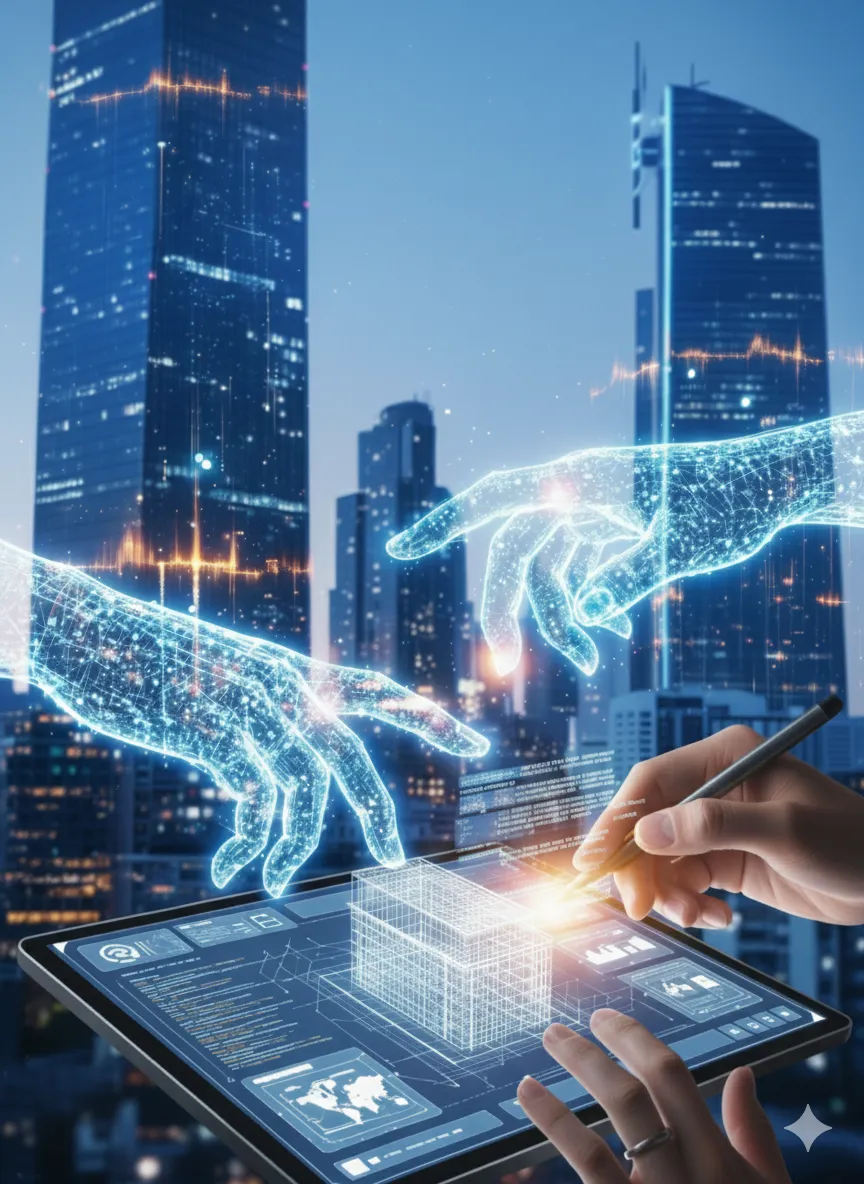
Sarah, who holds a role that doesn’t exist yet in 2024 called AI Experience Architect, starts her Monday differently. She opens her laptop and begins a conversation with an AI design partner. She describes what users need from the new dashboard, not in terms of buttons and colors, but in terms of emotions and goals. Within fifteen minutes, she has three working prototypes. Each one has been automatically checked for technical feasibility, accessibility compliance, and brand consistency. By lunch, real users have tested all three versions, and the winning design is ready for development.
This isn’t magic or science fiction. This is the result of a fundamental shift in how creative work gets done when humans and artificial intelligence learn to work together as partners rather than competitors.
The traditional design process that Jennifer and her team follow in 2024 is breaking down or because designers aren’t talented or hardworking. The process itself has become the bottleneck. Modern digital products have grown so complex that no human team can hold all the requirements, constraints, and possibilities in their heads at once. Users expect products to update constantly, to work perfectly across dozens of devices, to be both powerful and simple. Meeting these expectations with traditional methods is like trying to build a skyscraper with hand tools.
Consider what happens in a typical design project today. A product manager writes requirements based on their understanding of what users want. These requirements go to designers who interpret them through their own lens of creativity and experience. The designs then go to developers who have to figure out how to build them within technical constraints the designers might not have fully understood. At each handoff, something gets lost in translation. By the time the product reaches users, it might solve a different problem than anyone intended.
This process worked well enough when software was simpler and release cycles were measured in years. But today’s reality is different. Companies need to ship updates weekly or even daily. They need to test dozens of variations to see what works best for different user segments. They need to ensure consistency across web, mobile, tablet, smart TV, voice assistant, and platforms that haven’t been invented yet.
The pressure on design teams has become unsustainable. A recent survey found that the average designer spends only 20 percent of their time actually designing. The rest goes to meetings, documentation, revisions based on stakeholder feedback, and recreating designs that already exist somewhere else in the company. Talented designers burn out and leave the industry, creating a talent shortage that makes the problem even worse.
Meanwhile, the business cost of slow design has become unbearable. Every day a product improvement sits in design limbo is a day competitors can get ahead. Every week spent debating color schemes is a week of lost revenue. Companies that can’t move fast enough simply won’t survive.
This is why the transition to AI-native design is an inevitability more than an opportunity. The companies that figure out how to leverage AI as a creative partner will move so much faster than traditional competitors that the market will force everyone else to follow or fail.
Most people think AI will replace designers, turning creative work into a purely automated process. That’s not what’s happening. AI is becoming a powerful amplifier of human creativity. It takes care of the repetitive, time-consuming parts of design so humans can focus on what they do best: understanding people, imagining new possibilities, and making the judgment calls that require wisdom and experience.
Think of it like the transition from hand-drawn architectural blueprints to computer-aided design. CAD software didn’t replace architects. It freed them from the mechanical aspects of drawing so they could spend more time on the creative and strategic aspects of their work. The same thing is happening now with AI and digital design, just on a much larger scale.
The AI-native design process changes everything about how creative teams work. Rather than spending weeks on initial concepts, designers can explore hundreds of ideas in hours. They can test it instantly instead of guessing whether users will like something. No more manually checking whether a design follows brand guidelines. AI ensures consistency automatically. Recreating the same components over and over will be a thing of the past because designers build intelligent systems that evolve and improve themselves.
This shift requires new skills, new roles, and new ways of thinking about creativity itself. The designers of 2030 won’t be people who are good at using Photoshop or Figma. They’ll be people who understand how to communicate creative vision to AI systems, how to evaluate and refine AI-generated solutions, and how to ensure that technology serves human needs rather than the other way around.
Some people fear this future. They worry that AI will make human creativity less valuable or that design will become formulaic and soulless. These fears are understandable but misguided. AI doesn’t diminish the importance of human creativity; it amplifies it. When designers don’t have to worry about the mechanical aspects of their craft, they can focus on the parts that truly matter: understanding users, solving problems, and creating experiences that improve people’s lives.
The transition we’re about to explore in this book focuses on reimagining what creative work can be when humans and machines work together as partners, and building design processes that are faster, better, and more humane than what we have today. It’s also preparing for a future that’s already beginning to arrive, like it or not.



Comments